


Resources » Conflicts » A spatial risk map of gray wolf livestock depredations across the Great Lakes Region
A spatial risk map of gray wolf livestock depredations across the Great Lakes Region
March 31, 2026
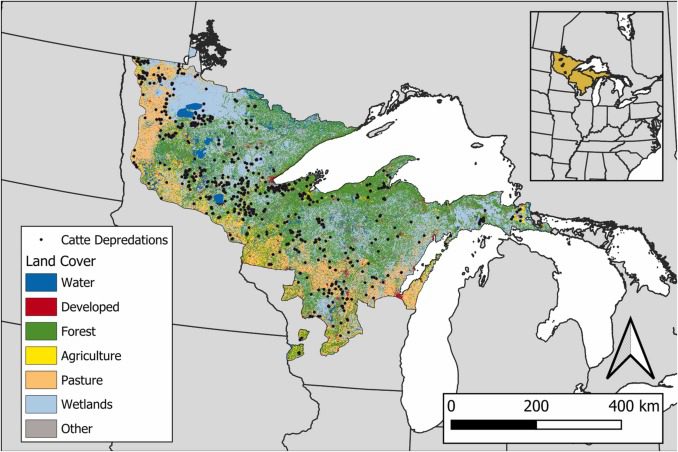
Livestock depredations by gray wolves are a source of human-wildlife conflict across their recolonizing range in the midwestern United States of America (USA) which may hinder recovery efforts. Spatial prediction of livestock depredation risk is an important component of preventing and mitigating livestock depredation. We provide the first livestock depredation risk map for gray wolves (Canis lupus) throughout their current range in the midwestern USA. Using an ensemble model with two-step validation approach, we analyzed 1239 reported wolf depredations of livestock across Minnesota, Wisconsin, and Michigan USA during 2010–2022 to identify factors influencing risk. Depredation probability was primarily influenced by the proportion of pasture cover (variable importance = 0.975), increasing rapidly as the amount of pasture increased. In contrast, depredations were not substantially influenced by proportion of forested land, proportion of developed land, or cattle density (variable importance < 0.05 for each). Our results indicate that depredation probability increases substantially when even small amounts of livestock pasture overlap with wolf habitat. Our models predicted the locations of depredations with high accuracy as measured by cross-validated performance without wolf-specific predictor variables such as distance to nearest pack. Proactive mitigation efforts in these high-risk areas may reduce conflict with humans as wolf range expands. We suggest that models of human-wildlife conflicts not dependent on difficult-to-obtain wildlife data could be an effective tool for identifying conflict hotspots across large spatial extents, particularly for recolonizing species.
Document: 1-s2.0-S2351989426001216-main.pdf 
Author(s): Jacob E. Hill, Kenneth F. Kellner, Dean E. Beyer Jr., John D. Erb, Nicholas L. Fowler, Mariela G. Gantchoff, John Hart, David M. MacFarland, Tyler R. Petroelje, Jennifer L. Price Tack, Brian J. Roell, David Ruid, Jerrold L. Belant
READ MORE: https://www.sciencedirect.com/science/article/pii/S2351989426001216
This entry was posted in Conflicts, Resources and tagged Canis lupus, carnivore, Human–wildlife conflict, livestock depredation, recolonization. Bookmark the permalink.
 Ecological Studies of Wolves on Isle Royale 2025-2026
 Anthropogenic sources dominate gray wolf mortality but leading cause varies with management regime

