


Resources
Resources

Species Richness Within an Urban Coyote (Canis latrans) Territory in Atlanta, Georgia, USA
August 30, 2019
Atlanta, GA, USA, has been one of the fastest growing metropolitan areas in the US over the past several decades, with a human population now close to 6 million. Urbanization has been rapid and widespread, thereby creating a highly fragmented … read more
Posted in General, Predator/Prey Relationships | Tagged canis, coyote, latrans, richness, species, urban, within

Wolves contribute to disease control in a multi-host system
August 30, 2019
We combine model results with feld data for a system of wolves (Canis lupus) that prey on wild boar (Sus scrofa), a wildlife reservoir of tuberculosis, to examine how predation may contribute to disease control in multi-host systems. Results show … read more
Posted in Benefits of Wolves | Tagged contribute, control, disease, multi, system, wolves

Spatial associations of livestock guardian dogs and domestic sheep
August 30, 2019
Livestock guardian dogs (Canis lupus familiaris; LGDs) have been used for centuries to protect livestock, primarily domestic sheep (Ovis aries), from depredation by large carnivores. While previous studies have shown their efficacy, the mechanisms in which LGDs protect livestock have … read more
Posted in Non-Lethal Management Tools | Tagged associations, domestic, guardian, livestock, sheep, spatial
Reciprocity in Restoration Ecology: When Might Large Carnivore Reintroduction Restore Ecosystems?
July 6, 2019
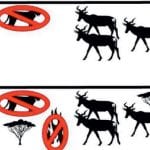
Carnivore reintroduction is often expected to revert community and ecosystem properties to their natural states via risk effects and the direct killing of prey. Because large carnivore extirpation and reintroduction are usually believed to have symmetric and offsetting effects, fulfilling … read more
Posted in Trophic Cascade | Tagged carnivore, ecology, large, might, reciprocity, reintroduction, restoration

Can Large Carnivores Change Stream via Trophic Cascade?
July 6, 2019
Large carnivores were persecuted in Yellowstone National Park, WY, USA, during the late 1800s and early 1900s, leading to extirpation of grey wolves (Canis lupus) and cougars (Puma concolor). Soon thereafter increased herbivory of riparian plant communities by Rocky Mountain … read more
Posted in Trophic Cascade | Tagged carnivores, cascade, change, large, stream, trophic

Wolves for Yellowstone: Dynamics in Time and Space
July 6, 2019
The reintroduction of gray wolves (Canis lupus) to Yellowstone National Park is the most celebrated ecological experiment in history. As predicted by population models, the rapid recovery of a wolf population caused both temporal and spatial variability in wolf–ungulate interactions … read more
Posted in Trophic Cascade | Tagged dynamics, space, wolves, yellowstone

